
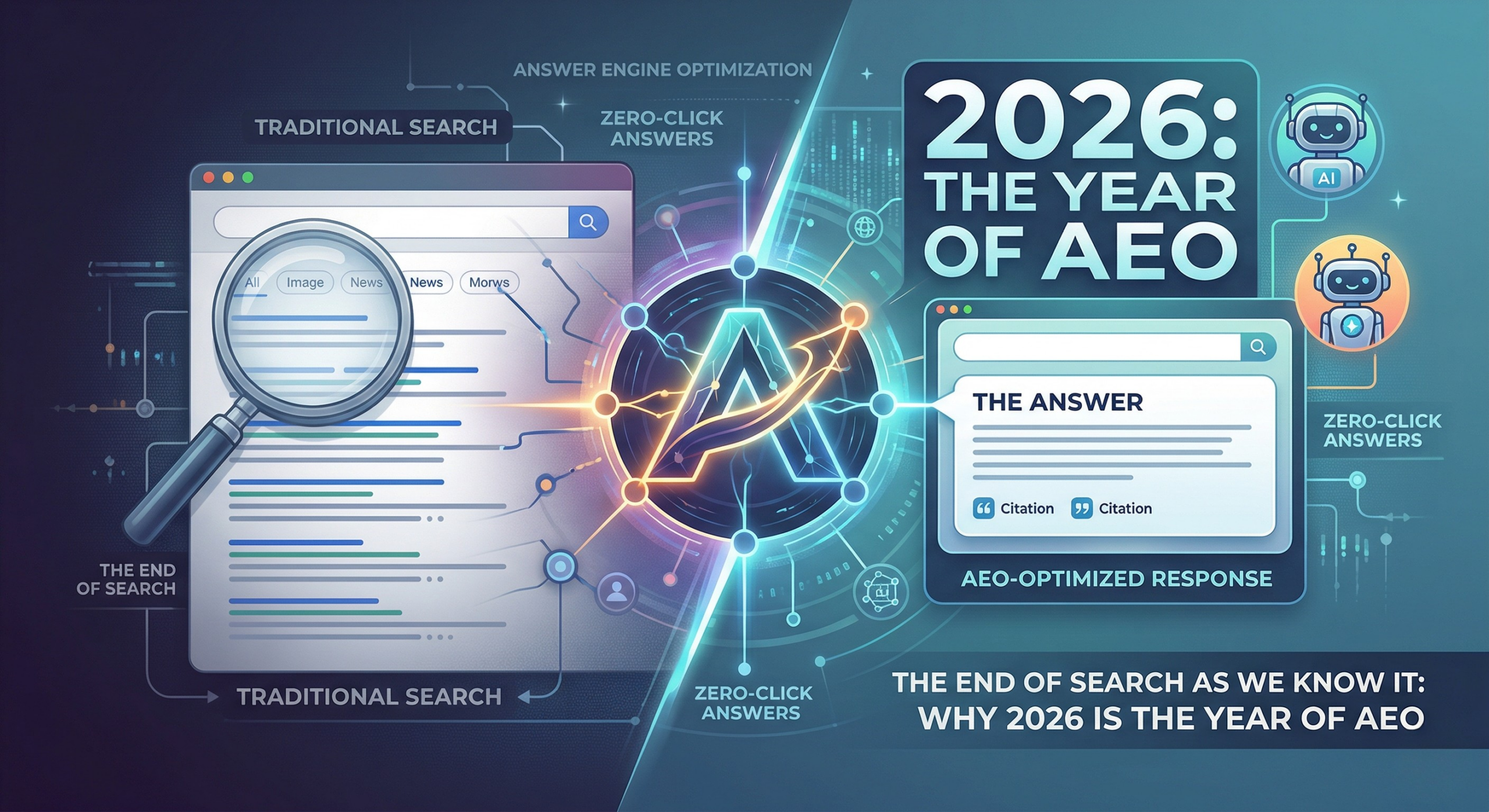

Search hasn’t disappeared. It has changed form.
In 2026, users don’t browse results, they ask AI and get one synthesized answer. The brands
inside that answer get attention. Everyone else disappears, regardless of how well they rank.
The question is no longer: How do I rank?
It’s: Will I be included in the answer?
Table of Contents
Quick Answer: What Is AEO?
Answer Engine Optimization (AEO) is the practice of structuring content so AI systems, including ChatGPT, Google AI Overviews, and Perplexity – can extract, verify, and cite your information when generating responses to user queries, without requiring users to click your website.
Unlike SEO, which optimizes for rankings, AEO optimizes for selection: getting your content chosen as the source inside an AI-generated answer.
Why AEO Matters in 2026: The Data
The shift from ranking to selection is being driven by measurable, compounding changes across search behavior, platform adoption, and revenue flow.
The search volume collapse
- Global search engine query volume is projected to drop ~25% by 2026, accelerating toward steeper declines by 2028, as users migrate to AI assistants and virtual agents (Gartner, 2025)1
- Around 50% of Google searches now surface AI summaries; McKinsey estimates this could exceed 75% by 2028 (McKinsey, 2025)2
- ~$750 billion in US revenue is expected to be influenced or routed through AI-powered search experiences by 2028, not classic SERPs
Zero-click behavior and CTR collapse
- 60–70% of Google searches now end without a click; mobile zero-click rates reach 75–77% (Bain, 2025; SparkToro / Datos3)
- When a Google AI Overview is present, organic CTR falls from ~15% to ~8% – Ahrefs’ 2026 data estimates up to a 58% drop in clicks in high-AIO scenarios
- Google AI Overviews appear in roughly 25% of all Google searches, with Health (48.7%) and Finance (25.7%) seeing the highest penetration
- Google AI Mode sees a 93% zero-click rate vs. ~43% for standard AI Overviews; users spend 49 seconds in AI Mode vs. 21 seconds in AI Overviews
Consumer and B2B adoption
- 50% of consumers now intentionally seek out AI-powered search when researching purchases; 44% rank it as their primary digital source of insight, ahead of traditional search, brand sites, and review platforms
- 89–95% of B2B buyers are now using generative AI at some point in their buying journey, from early research through to vendor comparison
The AI referral traffic opportunity
- AI referral traffic accounts for 1.08% of all website visits across enterprise domains today – but is growing ~1% month-over-month; ChatGPT alone drives 87.4% of all AI referral traffic
- ChatGPT now has 700–800 million weekly users processing ~2.5 billion prompts per day – the largest single AI discovery surface by a wide margin
- 35–45% of Fortune 1000 companies are already running formal AEO programs; the AEO software market is valued at $1.2–2.0 billion in 2026, growing at 45–60% per year
- Early AEO adopters report 3–6× improvements in AI citation rate over 6–12 months; AI originated referrals show 2–3× higher engagement (time on site, pages per session) vs. average organic traffic
The strategic implication: Search engines used to rank pages. AI now selects answers. If your content isn’t selected, it doesn’t appear – regardless of your domain authority or ad spend.
AEO vs SEO: What’s Actually Different
Most teams treat AEO as “SEO 2.0.” That framing misses the core distinction.
| Factor | SEO | AEO |
| Goal | Rank pages in search results | Get cited inside AI-generated answers |
| Output | Blue links | AI-generated responses with citations |
| Primary metric | Organic traffic / rankings | AI citations + brand mentions in answers |
| Secondary metric | Click-through rate | Referral traffic from AI platforms |
| Success signal | Position 1–3 | Inclusion in the answer |
| Content structure | Keyword-dense, long-form | Answer-first, structured for extraction |
| Trust mechanism | Backlinks + domain authority | Entity consistency + cross-platform verification |
SEO and AEO are not mutually exclusive. Strong SEO foundations (technical health, authority, structured content) support AEO performance. But AEO requires an additional layer of optimization that SEO alone does not address.
How AI Actually Selects Content: The AEO Selection Model
AI answer engines do not rank your page. They evaluate it through a four-stage selection process. Failing at any stage means you don’t get cited.
Stage 1 – Extraction: Can AI read your content?
The AI must be able to parse and understand your content cleanly. This requires:
- A direct answer to the query within the first 50–75 words
- Clear hierarchical structure (H2s, H3s, bullet lists, tables)
- No content buried inside JavaScript-rendered elements
- Schema markup that signals content type (FAQ, How To, Article, Dataset)
Common failure point: Long introductions, vague headings, and walls of text all reduce
extractability, even if the underlying information is strong.
Stage 2 – Verification: Does the internet agree with you?
This is the most overlooked stage, and the most important for brands.
AI systems cross-reference your content against multiple external sources before citing you:
| Source type | Examples | What AI checks |
| Your own web presence | Website, landing pages | Claims, positioning, named entities |
| Professional networks | LinkedIn, company profiles | Author credentials, company description |
| Community platforms | Reddit, Quora, niche forums | What real users say about your brand |
| Review platforms | G2, Trustpilot, Google Business | Sentiment, consistency of reputation |
| Editorial coverage | Industry blogs, trade press, Forbes | Third-party validation of claims |
| Knowledge bases | Wikipedia, Wikidata | Entity records and factual consistency |
| Multimedia | YouTube, podcasts | Spoken brand mentions and expertise signals |
The verification principle: In AEO, truth is not what you publish – it is what the internet consistently says about you. If your website claims you are the “leading platform for X” but no external source corroborates that, AI will discount your content.
Example: If your website claims “Top AEO agency for SaaS,” but no LinkedIn discussion supports it, no client reviews mention it, and no third-party site validates it, AI will not treat this as a fact. It will treat it as marketing. The claim simply won’t survive the verification stage.
Stage 3 – Trust: Is your brand credible?
Credibility in AI search is built from entity signals, not just domain authority:
- Does a consistent brand entity exist across web, social, and knowledge bases?
- Are named authors cited externally with verifiable credentials?
- Do third-party sources mention your brand in relevant contexts?
- Is your review profile positive and current?
Stage 4 – Citation: Do you get selected?
Even with strong extraction, verification, and trust signals, you only get cited if your content add something the AI cannot easily find elsewhere:
- Original data, research, or benchmarks
- A clearly defined proprietary framework or methodology
- A unique perspective backed by cited evidence
- Answers structured more precisely than competing sources
The key insight: AI doesn’t cite the “best” content, it cites the most defensible content. Defensible means verifiable, structured, and impossible to confuse with a generic summary.
Mental model: Think of AEO as a pipeline: Readable → Verifiable → Trustworthy → Citable. A gap at any stage breaks the chain. Most brands stall at stage two.
The 5 Pillars of AEO: Implementation Framework
Pillar 1 – Answer-First Content
Structure every piece of content to answer the core query within the first 50 words. AI systems extract early. Long introductions, disclaimers, and table-of-contents preambles reduce your citation probability.
Format signals that improve extraction:
- Direct definitions (“X is…”)
- Numbered step sequences for processes
- Comparison tables for multi-option topics
- FAQ sections using conversational question phrasing
Speed of impact: Reformatting existing content into answer-first, question-led blocks typically yields a 40–60% lift in AI summary inclusion within 4–8 weeks, one of the fastest ROI moves in AEO.
Pillar 2 – Structured Data Markup
Schema markup does not directly cause AI citation, but it removes friction from the extraction process. The performance data now backs this up: adding robust FAQ schema delivers a 2.3× improvement in AI citation rates within 2–4 weeks, and deploying LLMs.txt (AI-crawler directives that signal which content is available forAI indexing) produces a 15–25% improvement in AI crawler coverage within 2–6 weeks.
Priority schema types for AEO:
- FAQ Page – makes individual Q&A pairs directly extractable; highest ROI schema type for citation rate
- How To – structures process content for step-by-step citations
- Article with
authoranddateModified– signals freshness and authorship - Dataset – for content anchored to original data
- Speakable – for content targeting voice AI interfaces
- LLMs.txt – not schema, but a crawler-directive file that tells AI systems which content on your domain is available for indexing; becoming standard practice for AEO-focused sites
Speed of impact: Adding robust FAQ schema delivers approximately a 2.3× improvement in AI citation rates within 2–4 weeks. Deploying LLMs.txt (AI-crawler directives) typically yields a 15–25% improvement.
Pillar 3 – Entity Consistency
Your brand, product names, and key claims must appear consistently across every platform where AI looks for verification (see Stage 2 above). Inconsistencies – different product names, conflicting positioning, missing profiles, reduce your trust score.
Practical audit: Search your brand name + core product claims in ChatGPT and Perplexity. If the AI generated description doesn’t match your own positioning, your entity signals are inconsistent.
Pillar 4 – Information Gain
AI systems prefer original sources over summaries. Content that only aggregates existing knowledge has low citation probability. To increase information gain:
- Publish original survey data or benchmarks with methodology notes
- Create proprietary frameworks with named terminology
- Document case studies or experiments with specific, verifiable outcomes
- Take a clear, defensible position on debated industry questions
Pillar 5 – Multi-Platform Distribution
AI trains on and indexes content from multiple platforms simultaneously. Publishing only on your website limits your verification footprint. Distribute content across:
- Your website (canonical source)
- LinkedIn articles (professional authority signal)
- Reddit or niche community platforms (peer validation signal)
- YouTube (multimedia mention signal)
- Guest posts on industry publications (third-party editorial signal)
AEO in Practice: A 30-Day Case Study
The five pillars above aren’t theoretical. Here’s what they produced for a real brand that started from zero AI visibility.
The brand: A premium handmade designer footwear label specializing in luxury Indian-inspired designs, strong on craftsmanship, invisible in AI search.
The problem: When potential customers asked ChatGPT or Perplexity about luxury Indian footwear or handmade designer shoes, competitors owned every answer. This brand didn’t exist in any AI response.
The approach: Rather than chasing broad visibility, the campaign focused on owning one high value, commercially specific topic cluster “Indian Designer Footwear”, where purchase intent was highest and AI competition was lowest. This is Pillar 1 (answer-first, targeted content) combined with Pillar 5 (multi-platform distribution) in practice.
The 30-day execution ran in four phases: intent mapping across 200+ conversational queries, content restructuring to answer the questions AI users actually ask, a citation network built through fashion directories and cultural heritage databases, and daily visibility tracking across 50+ key queries.
Results at 30 days:
| Metric | Result |
| ChatGPT traffic growth | +400% (10 sessions → 47 sessions month-on-month) |
| AI engagement rate | 91.49% – significantly above site average |
| Category visibility | 50% share of voice for “Indian Designer Footwear” on ChatGPT |
| Market position | 4 in category – ahead of established competitors with larger budgets |
| Total AI citations | 370 (+140 new citations in 30 days) |
| Sessions per AI-referred user | 8.77 events vs. 7.50 site average |
The critical insight from this campaign: category dominance outperforms broad visibility. Owning 50% of one specific, high-intent topic cluster delivered more measurable business impact than thin presence across many topics would have. AI systems rewarded depth and authority within a niche, not generic coverage.
This also illustrates the verification principle from Stage 2: the citation network (fashion directories, craft association sites, cultural heritage databases) didn’t just build backlinks, it created the cross-platform signal web that AI systems use to verify brand legitimacy. Without that off-page work, the on-page optimization alone would not have moved visibility.
The first-mover reality: This brand entered a category where competitors had not yet invested in AEO. That window closes. The brands that establish category authority now will be significantly harder to displace once the space matures, exactly as early SEO adopters discovered in the mid-2000s.
Where AEO Matters: The AI Interface Ecosystem
Optimizing for AEO means optimizing for citation across multiple AI interfaces, not just Google:
- ChatGPT / GPT-4o – 700–800M weekly users; drives 87.4% of all AI referral traffic today
- Google AI Overviews – present in ~25% of all searches; up to 48.7% in Health queries
- Google AI Mode – 93% zero-click rate; users spend 2× longer than in standard AI Overviews
- PerplexityAI – citation-heavy responses with source links; high-intent, research-mode users
- Microsoft Copilot – integrated into Windows, Edge, and Microsoft 365 workflows
- AI copilots in SaaS tools – Notion AI, Slack AI, HubSpot Breeze, and others that pull external content
- Voice assistants – Siri, Alexa, and Google Assistant increasingly route to AI-generated answers
A brand that appears in ChatGPT answers but not Google AI Overviews (or vice versa) has a partial AEO strategy. Full coverage requires consistent entity presence and structured content recognizable across all these systems.
Measuring AEO Performance
Traffic is no longer the primary KPI for AI-visible content. Recommended tracking framework:
| Metric | How to measure |
| AI citation frequency | Manual prompting in ChatGPT, Perplexity, Gemini with your target queries |
| Brand mention in AI answers | Tools: Profound, Goodie AI, Outterly.AI, Writesonic, Brand-Sight (emerging category) |
| AI-referred traffic | GA4 – filter sessions from perplexity.ai, chatgpt.com, bing.com/chat |
| Featured snippet ownership | Google Search Console + third-party rank trackers like AHREF, SEMrush, etc. |
| Entity consistency score | Manual audit against Wikipedia, Wikidata, LinkedIn, Google Knowledge Panel |
Frequently Asked Questions
Is AEO replacing SEO?
No. AEO builds on SEO foundations – technical health, page authority, and quality content still matter. But the optimization layer above those foundations has shifted from ranking signals to citation signals. Teams that ignore AEO are optimizing for an increasingly smaller share of search behavior.
How do you get cited in ChatGPT or Perplexity?
You don’t rank in these systems, you get selected. The selection criteria are structured content, verified entity signals, and original information that the AI cannot easily reconstruct from other sources.
Does schema markup directly improve AI citation?
Not directly, but it significantly improves extractability, the first stage of the selection process. Schema makes it easier for AI to identify what type of content you have and pull specific elements (questions, steps, definitions) accurately.
What content formats perform best for AEO?
Direct definitions, FAQ sections, step-by-step guides, original research with stated methodology, and comparison tables. Long-form narrative content without clear structural hierarchy performs poorly for AI extraction regardless of quality.
Can small or newer brands win in AEO?
Yes and often more easily than in traditional SEO. AEO rewards original insight and entity consistency over domain age and backlink volume. A brand with a genuine proprietary dataset or a clearly defined niche can outperform larger competitors that publish generic, unsourced content.
What is the difference between AEO and GEO (Generative Engine Optimization)?
The terms are often used interchangeably. Some practitioners use GEO specifically to describe optimization for generative AI platforms (ChatGPT, Perplexity), while AEO is used more broadly to include voice and featured snippet optimization. The underlying practices are the same.
How quickly can AEO show results?
Quick wins are achievable in 2–8 weeks: FAQ schema improvements show citation lifts in 2–4 weeks; answer-first content reformatting delivers 40–60% lift in AI summary inclusion within 4–8 weeks. Full citation authority typically builds over 6–12 months, with early adopters reporting 3–6× citation rate improvements in that window.
Key Takeaways:
- AI answer engines select content, they don’t rank it. The shift from “ranking” to “being cited” requires a different optimization strategy.
- The verification stage (off-page AEO) is where most brands fail. Consistent entity signals across the web matter as much as on-page structure.
- Original data and proprietary frameworks are the highest-leverage investment for citation probability.
- AEO is not a replacement for SEO, it is the layer above it.
- Measure success in AI citations and brand mentions in AI answers, not just organic traffic.
Over the next 1–2 years, most discovery will happen without a click. The brands that win will not be the most visible in search results, they will be the most present inside answers.
If your brand isn’t showing up when your target customers ask AI tools about your category, you don’t have a traffic problem, you have a visibility problem. AEO is how you solve it.
